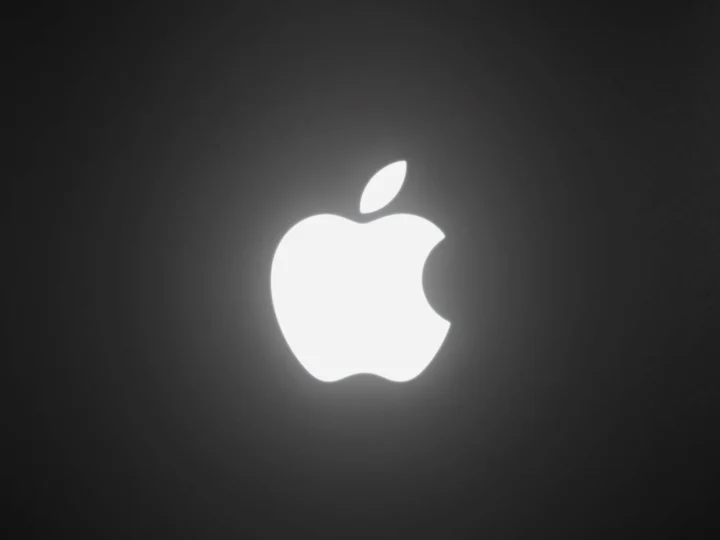

iFixit tore down the recently released 14-inch MacBook Pro with PROLED XDR Display, Apple’s very first touchscreen Mac, to see how the glowing logo works. Old MacBooks used the LCD backlight shining through an apple-shaped cutout, but this time around, Apple had to reinvent the mechanism because the OLED display has no backlight. Since each pixel lights itself, the glowing Apple logo needs a dedicated light source.
How the glowing Apple logo lights up without a backlight
Four tiny LEDs sit in a strip behind the display under a taped patch, and they make the Apple logo light up on the touchscreen MacBook Pro. The light bounces off a reflective layer, then passes through a diffuser, so four points of light become one evenly glowing apple.
When it’s off, the logo has a mirror-like finish that looks like any other MacBook launched before it. Two rigid foam pads sit on either side of the logo, which likely support the OLED when you press the touchscreen. There’s one tiny caveat: fixing the logo means you have to take apart the whole display. iFixit called it “an insane repair path.”
iFixit couldn’t remove the OLED panel intact, and when it tried to, the glass separated and the screen cracked. The upside is that the display assembly still got lighter, from 485 grams to 384 grams, even after the addition of the touch layer and the LEDs.
How repairable the touchscreen MacBook Pro is
The touchscreen MacBook Pro with PROLED XDR Display and a glowing Apple logo scored 5 out of 10, one point better than the M5 MacBook Pro. Under iFixit’s stricter 2027 rules for soldered memory, it would drop to 4.
The good part derived in the MacBook Pro teardown is that only four screws hold the bottom cover. There’s no separate lid-angle sensor anymore, and Touch ID and the touchscreen kept working after the logic board was swapped. Touch ID failed that test on last year’s model.
The bad part is that both fans and the USB-C ports sit under the logic board, so replacing one means removing the board. The keyboard is built into the top case, so you have to remove the battery to reach a faulty one.
Memory and storage are soldered, so you don’t have any option to upgrade after you’ve made the purchase. The 72.6 Wh battery’s pull tabs tore easily, even on a new battery.
The hinge is nearly identical to the M6 MacBook Pro‘s, with no sign of the rumored iPhone Duo hinge tech. The speakers got heavier, 39 grams versus 29 grams on the M6 model. This could contribute to Apple’s claim of 50 percent deeper bass. The overall weight is 1.38 kg, which is 170 grams lighter than the 14-inch M6 MacBook Pro.
Overall, the new MacBook Pro with a glowing Apple logo is a fun throwback to older models, but one LED failure could turn it into a full display repair. That brings us to the question: is the glow worth it?